
TREE LINE
In the snow above the trees rage, loss and loyalty collide head on in a mess of primal violence.

It has been two nights tracking the wide-head. We are above the tree line now, where there is only snow and rock and wind. I prefer this. Prefer it to what the wide-head left of my people, all bloody and broken. I tense and my knuckles whiten against my spear-haft.
A scrabbling noise ahead. I look up and the he-wolf is there, his ears up.
Many moons past he came to our fire and shared our food and then joined our hunts. He had become like family and, with a dark hollow rage, I realise that he is now my only family.
I move up to where he waits. When I am almost there he moves on, nose to the ground. I’d never have tracked the wide-head this far without the wolf.
My wolf. My world entire.
The wide-head doesn’t know about the wolf. Half a day uphill from my ruined home he covered his tracks. I might have lost his there, but for the wolf. Another whole day and he went above the tree line, where the knife-sharp winds would have made tracking them impossible.
Not for the wolf. I think the wide-head has been cut and bleeds. There were darker patches in his spoor in the forest, and the wolf has unerringly led me to more.
They can’t know about the wolf. I wonder if they know about wolves, other than as teeth in the night.
I wonder what they know at all, and I wonder what had taken them to our fire to claim their flesh-prize.
I wonder, my brow furrowed, missing my footing on loose scree. The fall winds me and I grunt. I do not rise.
Maybe I should stay here and let the wind and cold and tired claim me.
Maybe the wolf, goaded by hunger, will turn on me.
There is a sound in my ear, and a presence above me. I feel warm breath and feel something wet on my cheek. The wolf is by my side, licking my face, like I am his young.
I look up and I cannot tell if the tears in my eyes are from the biting wind or if they spring from that well within me.
I get up. I must move. The he-wolf senses my urgency and we break into a half jog.
I can hear him whine. His tail curls. The wide-head cannot be far now, and must still be flesh-drunk, slowed from the charnel house that was my home.
He paces and then veers off. They’ve left the goat path. We enter the lee of that great mountain and there are new smells of fire, of meat. The meat smells like the great pigs we hunt.
Fury blooms behind my eyes and I am a blur of motion. I don’t need the wolf now, guided by rage and my senses but he is here with me, lost in my beserk.
I hear him growl and I look up and see a fire and a hunched shape behind it. I do not pause but reverse my grip on the spear, skidding into the hunter’s stance, and throw it.
I do not wait to see it land. I am running again, stone knife drawn.
The wide-head comes to meet me. I see blood on its flank.
It swings a branch-club at me but it is hurt and slow and I am inside its reach and my knife goes in again and again until I am looking in its eyes, in her eyes, my knife jammed into her jaw.
I hear a bark, two barks, and a whine. I spin, and there is another wide-head over my limp and bloody wolf.
He sees the ruin of his mate and I see my wolf and we scream together and collide, like two waves breaking together.
We fall and flail and then I am above, rock in my hands and I am bringing it down over and over.
Eventually the blood-mad falls and I stop my beating of a body whose life left it several blows ago.
Barely audible, I hear a whine.
Oh, my wolf.
I stand, and fall. The wide-head has struck my side with his own knife and I bleed bright crimson into muddy snow.
I drag myself to where my broken wolf whimpers and I hold his huge head. I sing to him.
I sing the songs my kin sung to me.
The songs sung when we made life-paintings in the western caves.
The songs I sung to my firstborn.
I sing and cry until my wolf breathes his last.
Then I scream rage and hollow spite at a cold cruel world, I scream so loud that it bounces down the valley and then I hear back the wolf-howl, joining my pain.
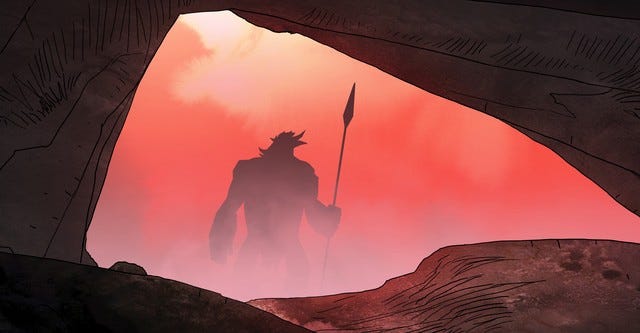
Image is taken from Genndy Tartakovsky’s superb Adult Swim series Primal which you really should check out. Find out where to watch it here: https://www.justwatch.com/uk/tv-series/primal
Historical note
In case you were wondering (and I know you have been since this is the question I get asked most), wide-heads are meant to be Neanderthals.
Our primate cousins (or maybe uncles) happily inhabited Europe and Western and Central Asia right up until our direct ancestors showed up and promptly wiped them out via the heady combination of fighting and/or fucking (not fun fact: the human genome contains about 6% Neanderthal genes, and we didn’t get those from fighting).
Because I’m basically an edgy teenager still, and I wanted crank up the stone-age horror vibes, I made the wide-heads evil cannibals and, in the process, neatly ripped off the Michael Crichton novel Eaters of the Dead. I’ve actually never read the book, but have watched the wonderfully schlocky (and slightly racially tricky) 13th Warrior film adaptation.
However, poor Homo neanderthalis wasn’t a cannibal (I do wonder if it’s still cannibalisation if you’re not eating the flesh of your own direct species) and was more likely just trying to hunt and/or gather in peace, although this doesn’t lend itself to a compelling narrative.
It’s also disputed as to whether we had domesticated canids at the point humans began spreading across Europe and Asia. The earliest officially confirmed remains of what could very well be the first goodest boy dates from around 14,000 BCE but there are disputed domesticated canid (because both wolves and dogs didn’t exist then, and were instead combined in a common ancestor) remains dating well back to around 40,000 BCE.
I really truncated the process of domesticating canids (see above re: compelling narrative) but really it took a while, as evidenced by anyone that has one of those dogs who will chase the ball, but just refuses to bring it back.
What did we do to deserve dogs eh?